How Old the Pyramids Really Are
Old enough to break your brain: Cleopatra lived closer in time to the first Moon landing than to the building of the Great Pyramid.
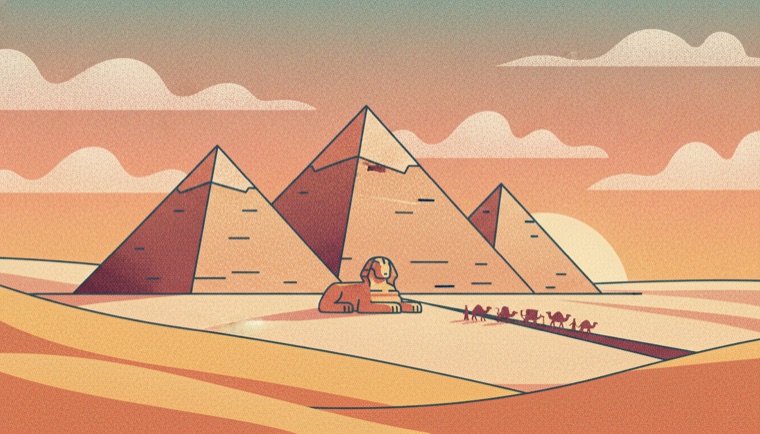
The number that breaks your brain
Cleopatra is closer to the Moon landing than she was to the Great Pyramid of Giza. That sounds like a trick until the dates do the work. Cleopatra died in 30 BCE. The Great Pyramid rose around 2560 BCE, under Pharaoh Khufu (Cheops) of the Fourth Dynasty. That makes the gap between Cleopatra and Khufu’s pyramid about 2,500 years—long enough for empires to rise, collapse, and become archaeology.
The Moon landing in 1969 CE sits just under 2,000 years after Cleopatra’s death. So the modern event is, in calendar terms, nearer to Cleopatra than Cleopatra is to the pyramid. The human brain hates this kind of math because “ancient Egypt” gets filed as one blurry block. But the pyramid refuses that blur. It forces a split between late Egypt and deep Egypt, between the Egypt of Cleopatra and the Egypt of Khufu.

Timeline
- c. 2600 BCE
Great Pyramid built
- 69–30 BCE
Cleopatra's life
- c. 450 BCE
Herodotus visits Egypt
- 1969 CE
Moon landing
Cleopatra is closer to the Moon landing than she was to the Great Pyramid of Giza.
Cleopatra was not living in pyramid time
Cleopatra is the wrong mental shortcut for the age of the Great Pyramid. She ruled in the Ptolemaic period after Alexander the Great conquered Egypt in 332 BCE. Her court spoke Greek. Her political world was Mediterranean and late, tied to Roman power and dynastic bargaining. She lived in an Egypt that had already been remade by conquest and translation.
Khufu’s Egypt belonged to the Old Kingdom, more than two millennia earlier. The Giza plateau was then a fresh royal project, not a tourist stop or a national symbol. By Cleopatra’s time, the Great Pyramid was already a relic from a vanished civilization inside Egypt itself. Nobody in her court was treating it as a new wonder; they inherited it the way modern people inherit cathedrals, ruins, and standards they did not build.

A monument old to the ancients
The most striking proof that the pyramid belongs to a different scale is that even the ancient Greeks saw it as ancient. Herodotus visited Egypt around 450 BCE and encountered a structure that was already about 2,000 years old. That means the pyramid had already outlived entire stretches of recorded history before Cleopatra was born. By the time Romans arrived, it was not a fresh marvel but an old one.
That is why the familiar image of Cleopatra standing alongside the pyramids distorts the timeline. She is historically close to the first century BCE and CE; the pyramid belongs to the third millennium BCE. The distance between them is larger than the gap between Cleopatra and the first landing on the Moon. It is also larger than the gap between Cleopatra and the age when Rome was still just becoming Rome.
The age of the pyramid is the point
Calling the Great Pyramid “old” understates the case. It was the tallest structure on Earth for about 3,800 years, until Lincoln Cathedral surpassed it in 1311 CE. That record matters because it shows how one building can outrun ordinary historical intuition. Most monuments age into irrelevance. The Great Pyramid aged into a permanent exception.
Its date also lands it in the early Bronze Age, before Alexander, before Rome, before Christianity, before the Persian conquest of Egypt, before Cairo, before the classical world even starts in the usual classroom sense. Put bluntly, the pyramid was already ancient before most of the names we use to organize Western history had arrived on the scene. The surprise is not just that it is old. It is that our favorite image of “ancient Egypt” sits thousands of years too late.
What the comparison fixes in the mind
The cleanest way to think about the Great Pyramid is not as a leftover from Cleopatra’s Egypt, but as an object Cleopatra inherited from a civilization that was already gone. Khufu built for an Old Kingdom state with the confidence of the third millennium BCE; Cleopatra ruled a late Hellenistic kingdom under the pressure of Rome. Those are not neighboring chapters. They are different books.
That is why the comparison to Apollo 11 lands so hard. It gives the pyramid a modern measuring stick and reveals how badly our intuitions fail. The Great Pyramid was already ancient when Cleopatra was born, and it has had another 2,000 years to age since she died. Once you see that, “ancient Egypt” stops meaning one era and starts meaning a vast stretch of time with a cliff in the middle.
3 things to remember
- 1The Great Pyramid was built around 2600 BCE, about 2,500 years before Cleopatra.
- 2Cleopatra belongs to Egypt's late Ptolemaic era, not the Old Kingdom that built Giza.
- 3The pyramid was already ancient to the ancients—and stayed the tallest structure on Earth until the 14th century CE.
Conversation spark
Cleopatra is a terrible timestamp for the pyramids. Khufu lived closer to the invention of writing than to Cleopatra.
Go deeper